Apply SciPy's correlate() to the waveforms of antenna pairs to determine incoming signal directions. More...
Functions | |
| pl.DataFrame | supply_azimuthal_angle_masks (pl.DataFrame skymaps) |
| Supplies azimuth masks to any sky map (eg time delay maps or correlation maps). | |
| pl.DataFrame | combine_time_delay_maps_and_waveforms (pl.DataFrame masks_and_skymaps, pl.DataFrame waveforms) |
| Prepares a big table that has all the column needed by cross_correlate. | |
| pl.DataFrame | cross_correlate (pl.DataFrame big_frame) |
| Compute the zero-centered normalized cross correlation (ZNCC) and makes correlation skymaps. | |
| [float, float] | _get_true_direction (ROOT.pueo.Dataset dataset) |
| Returns the true signal direction. | |
| None | plot_correlation_map (pl.DataFrame correlation_frame, str plot_name, true_phi=None, true_theta=None) |
| Plots the reult of cross_correlate. | |
Detailed Description
Apply SciPy's correlate() to the waveforms of antenna pairs to determine incoming signal directions.
Function Documentation
◆ supply_azimuthal_angle_masks()
| pl.DataFrame supply_azimuthal_angle_masks | ( | pl.DataFrame | skymaps | ) |
Supplies azimuth masks to any sky map (eg time delay maps or correlation maps).
- Parameters
-
[in] skymaps columns A1_PhiSector and A2_PhiSector are required
- Return values
-
phi_masks see the schema of the example output below
- Parameters:
- Input: required columns are the \(\phi\)-sectors of the antenna pairs, A1_PhiSector and A2_PhiSector.
- Output schema: one column (masks) will be attached to the input dataframe, $ A1_PhiSector <u8>$ A2_PhiSector <u8>$ masks <array[bool, (1, 360)]>
- Explanation:
- \(\phi\)-sector 1 is centered around 0 degrees azimuth, \(\phi\)-sector 2 around 15 degrees, and so on and so forth; the last \(\phi\) sector (24) is centered around 345 degrees.
- Based on the antenna's field of view, the values outside a certain range are dropped.
- In the figure below, we show what this would look like for antennas from the first three and the last \(\phi\)-sectors (white means masked).
- The chosen masking behavior for now is that only the data within the overlapping unmasked range would be kept.
- For instance, suppose an antenna from \(\phi\)-sector 1 is paired with an antenna from \(\phi\)-sector 2, then:
- Warning
- Thus, if the antenna pair's fields of view do not overlap, then everything will be masked.
Definition at line 34 of file locate_signal.py.
◆ combine_time_delay_maps_and_waveforms()
| pl.DataFrame combine_time_delay_maps_and_waveforms | ( | pl.DataFrame | masks_and_skymaps, |
| pl.DataFrame | waveforms ) |
Prepares a big table that has all the column needed by cross_correlate.
- Parameters
-
[in] masks_and_skymaps The output of supply_azimuthal_angle_masks [in] waveforms The output of waveform_plots.load_waveforms
- Return values
-
big_frame See sample output schema below.
- Parameters:
- The following columns are required in waveforms:
- AntNum
- waveforms (volts)
- step size (nanoseconds)
- Pol
- The following columns are required in masks_and_skymaps:
- A1_AntNum
- A2_AntNum
- time delays [sec]
- masks
- The output schema: $ A1_AntNum <enum>$ A2_AntNum <enum>$ Pol <enum>$ A1_waveforms (volts) <array[f64, 3072]>$ A2_waveforms (volts) <array[f64, 3072]>$ time delays [samples] <array[i64, (180, 360)]>$ masks <array[bool, (1, 360)]>
- The following columns are required in waveforms:
- Explanation:
- time delays [samples] refers to the time delay skymaps, with the units converted from seconds to "samples"
- That is, the units are in "steps" (step size (nanoseconds))
- The values in these time delay skymaps are therefore integers, serving as indices.
- These indices are then used later in cross_correlate when creating the correlation skymaps based on the time delay maps (via "fancy-indexing").
- Qualitatively, the time delay maps have not changed. For example: Time Delay Map in SecondsTime Delay Map in Samples
Definition at line 149 of file locate_signal.py.
◆ cross_correlate()
| pl.DataFrame cross_correlate | ( | pl.DataFrame | big_frame | ) |
Compute the zero-centered normalized cross correlation (ZNCC) and makes correlation skymaps.
- Parameters
-
[in] big_frame The output of combine_time_delay_maps_and_waveforms()
- Return values
-
correlation_maps See the schema of the example output below
Parameters: columns correlation and correlation maps will be added to the input, so the output schema looks like
$ A1_AntNum <enum>$ A2_AntNum <enum>$ Pol <enum>$ A1_waveforms (volts) <array[f64, 3072]>$ A2_waveforms (volts) <array[f64, 3072]>$ time delays [samples] <array[i64, (180, 360)]>$ masks <array[bool, (1, 360)]>$ correlation <array[f64, 6143]>$ correlation maps <array[f64, (180, 360)]>- correlation maps contain correlation skymaps. These are matrices with the same dimensions as the time delay maps of time delays [samples], as the former are made based on the latter via "fancy-indexing"
- Each matrix element of a correlation skymap is the correlation score between two waveforms, given some particular time delay, ie. phase shift.
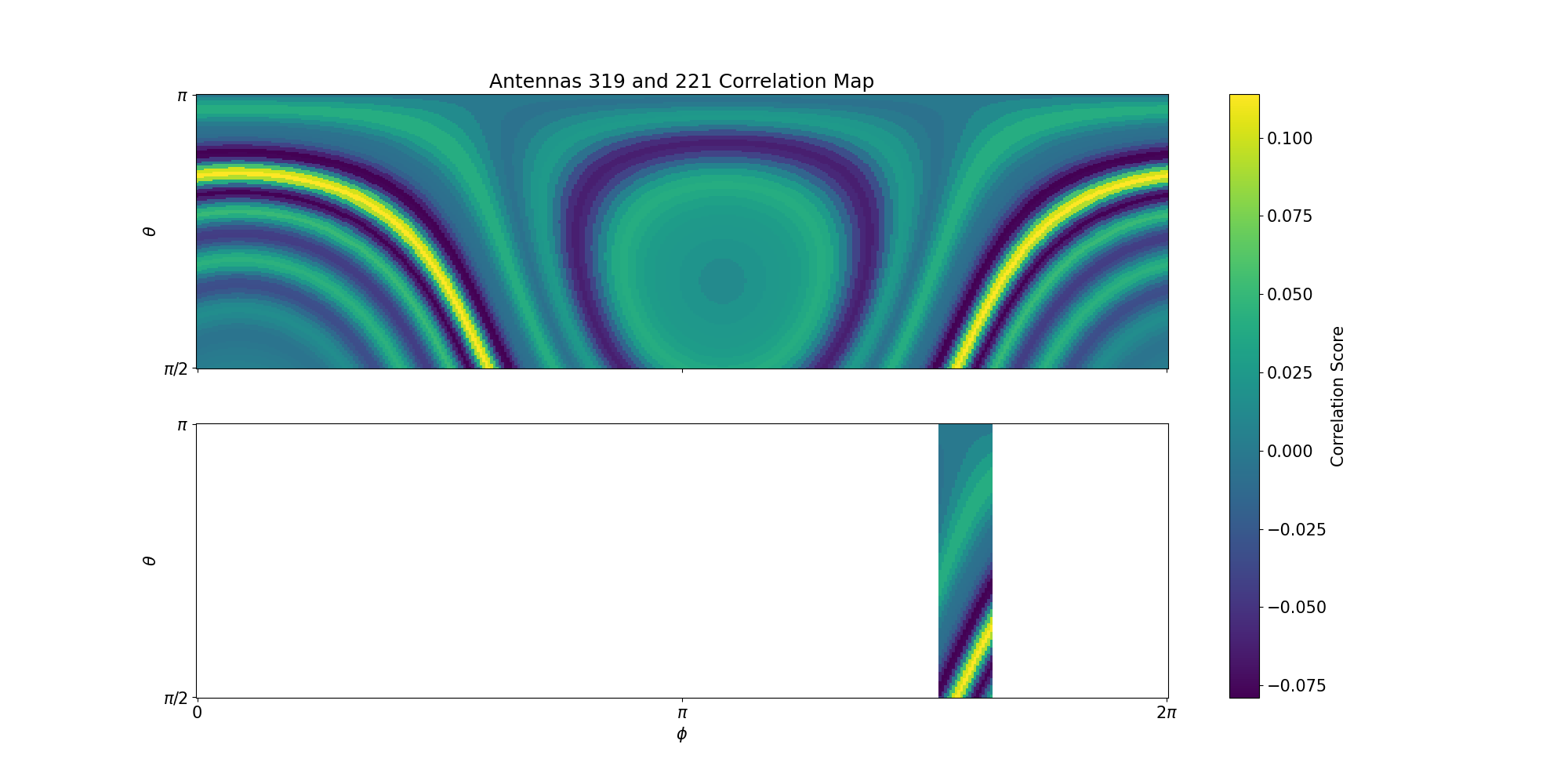
- masks can be used to mask the correlation maps, as shown in the bottom subplot in the Figure above. The masks are defined by supply_azimuthal_angle_masks.
- Explanation:
- Consider two waveforms,
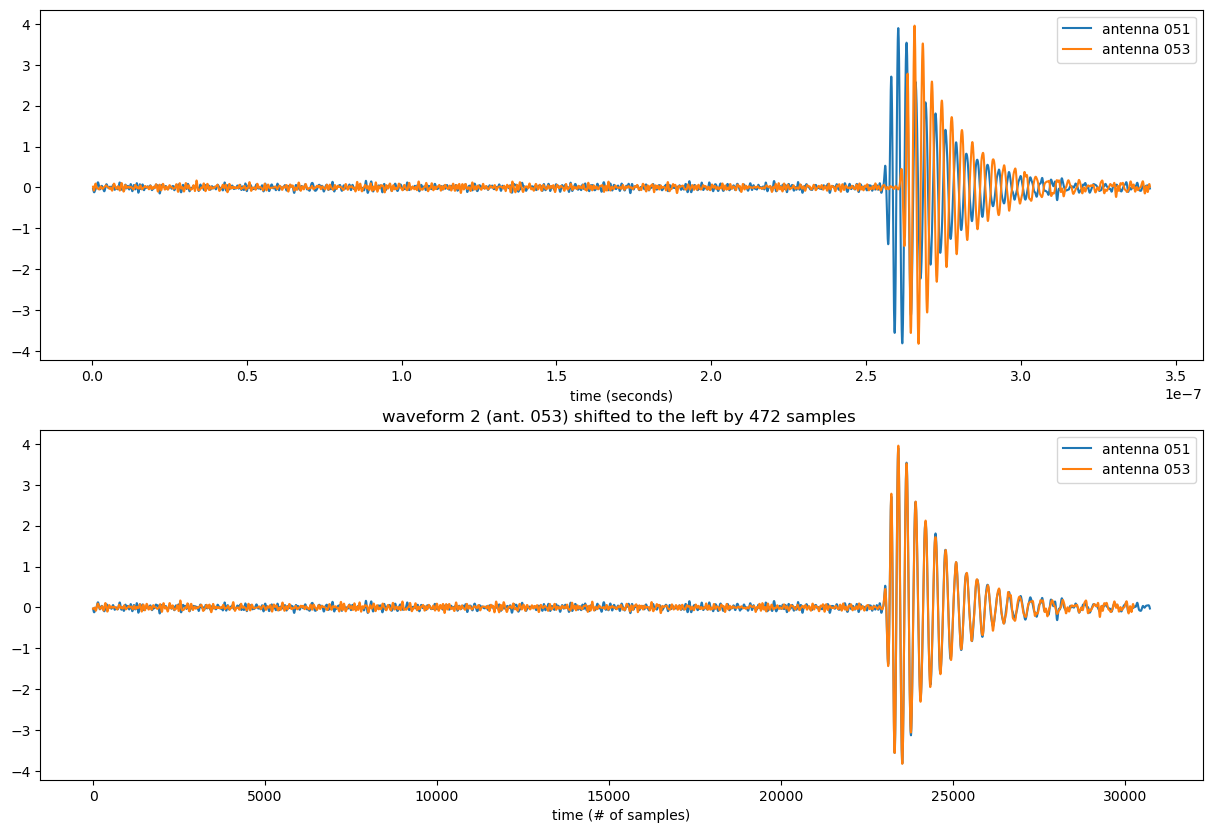
- Each row in the correlation column is an array of correlation scores.
- By shifting the waveforms we may be able to get them to align perfectly, at which point maximum correlation is achieved.
- The correlation score tells us how "aligned" the two waveforms are after we phase shift A1_waveforms (volts) against A2_waveforms (volts) by a certain amount of time.
- The waveforms are zero-centered and normalized such that the cross-correlation is bounded between [-1,1]. Zero means the waveforms are not aligned at all.
- See cross_correlation_and_time_delay.pdf or, for details, scipy_correlate_behavior.pdf.
- Consider two waveforms,
Definition at line 217 of file locate_signal.py.
◆ _get_true_direction()
|
protected |
Returns the true signal direction.
- Parameters
-
[in] dataset The output of initialise.load_pueoEvent_Dataset
- Note that as stored in the .root files, the variable RFdir_payload is the direction the signal is travelling to.
- Therefore, to obtain the direction that the signal is coming from, we need the opposite vector.
- Thus, \(\phi_{\rm true} = (\phi_{\rm rfdir} + 180 ^\circ) \% 360^\circ\), and \(\theta_{\rm true} = 180^\circ - \theta_{\rm rfdir}\)
Definition at line 299 of file locate_signal.py.
◆ plot_correlation_map()
| None plot_correlation_map | ( | pl.DataFrame | correlation_frame, |
| str | plot_name, | ||
| true_phi = None, | |||
| true_theta = None ) |
Plots the reult of cross_correlate.
- Parameters
-
[in] correlation_frame The output of cross_correlate [in] plot_name Remember to specify file type [in] true_phi (optional) from _get_true_direction [in] true_theta (optional) from _get_true_direction
- Required columns in correlation_frame:
- correlation maps
- masks
- Pol
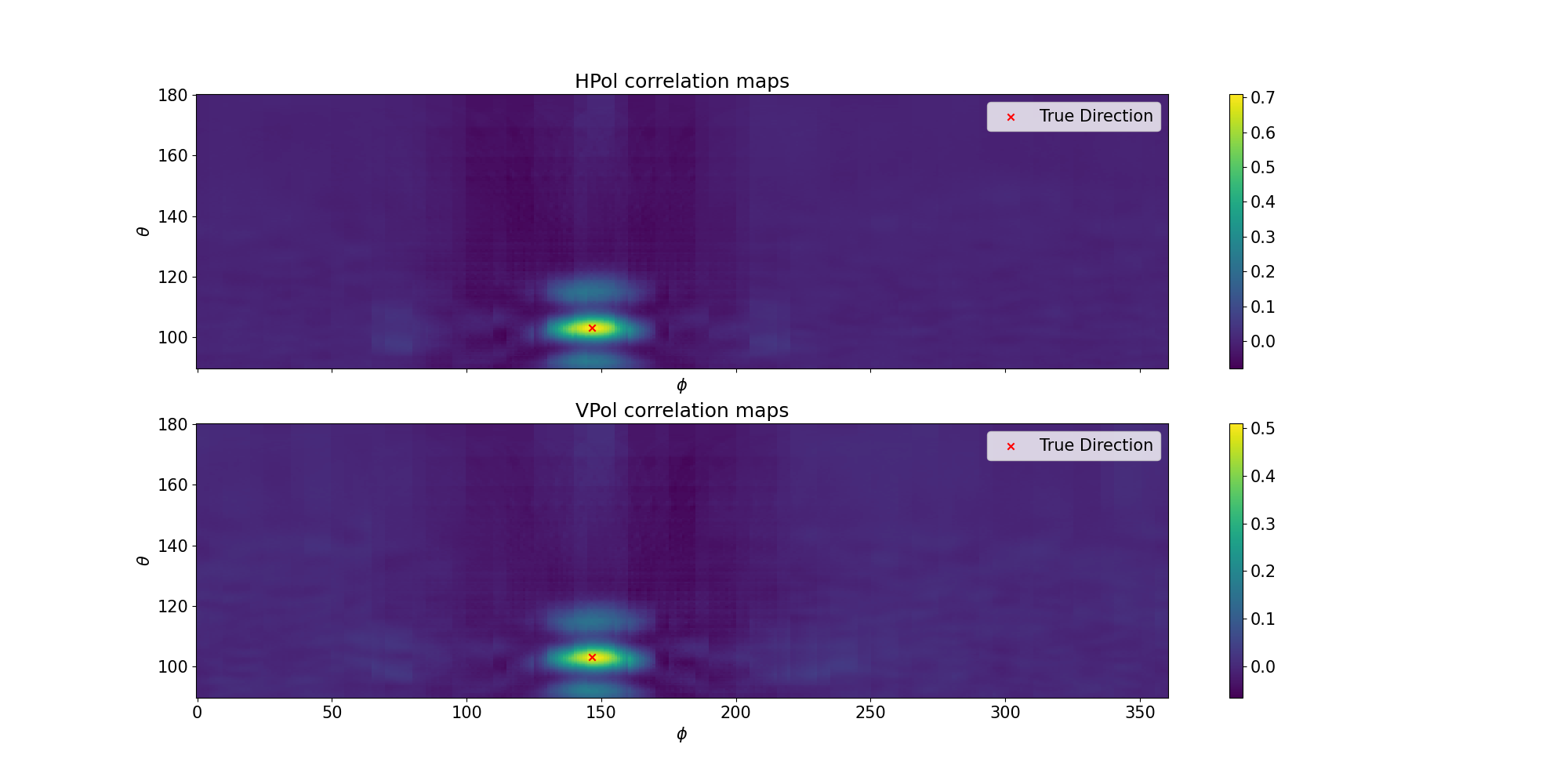
- Using only one antenna pair, one can find a band of peak correlation scores, see the plot in the file description.
- If we then sum over all antenna pairs, we would be able to identify a single peak:
Definition at line 319 of file locate_signal.py.