Loading...
Searching...
No Matches
Signal Delay
Time delays between antenna pairs due to incoming signal directions and antenna positions. More...
Functions | |
| tuple[np.ndarray, np.ndarray] | _make_grid (sparse=False) |
| Creates a 2D grid \((\phi, \theta)\) of azimuthal and zenith angles. | |
| tuple[np.ndarray, np.ndarray, np.ndarray] | _make_unit_vectors_on_bottom_hemisphere () |
| Returns unit vectors pointing to the origin from the surface of a unit bottom hemisphere. | |
| pl.DataFrame | make_time_delay_skymap (pl.DataFrame antenna_pairs) |
| Computes the expected incoming-signal time delays between antenna pairs based on pairwise displacement vectors and signal directions. | |
Detailed Description
Time delays between antenna pairs due to incoming signal directions and antenna positions.
See make_time_delay_skymap for details.
Function Documentation
◆ _make_grid()
|
protected |
Creates a 2D grid \((\phi, \theta)\) of azimuthal and zenith angles.
- Parameters
-
[in] sparse see NumPy's documentation
- Return values
-
phi azimuthal angle coordinates theta zenith angle coordinates
- This grid represents the "bottom hemisphere":
- Azimuthal angle range: \(0 < \phi < 2 \pi\)
- Zenith (not elevation!) angle range: \( \pi/2 < \theta < \pi\)
- The figure below shows a sparse grid as an example.
- Note
- The real grid currently in use is 180-by-360 (i.e. 360 points for \(\phi\), 180 points for \(\theta\))
Example 30-by-3 grid
Definition at line 30 of file time_delays.py.
◆ _make_unit_vectors_on_bottom_hemisphere()
|
protected |
Returns unit vectors pointing to the origin from the surface of a unit bottom hemisphere.
- Return values
-
incmoing_x incmoing_y incmoing_z
- Calls _make_grid() to generate a 2D grid of \(\phi\)s and \(\theta\)s.
- Converts each point on the grid into Cartesian coordinates; assuming r=1:
- \( x = \sin\theta \cdot \cos\phi \)
- \( y = \sin\theta \cdot \sin\phi \)
- \( z = \cos\theta \)
- Each point is a unit vector pointing from the origin to somewhere on the hemisphere.
- Thus, the unit vector \(\hat{\bf{u}}\equiv(-x,-y,-z)\) represents a possible (incoming) signal direction, assuming that the payload is at the center of the sphere.
- The unit bottom hemisphere: incoming_x, incoming_y, incoming_z = _make_unit_vectors_on_bottom_hemisphere()fig = plt.figure()ax = fig.add_subplot(projection='3d')ax.plot_surface(-incoming_x, -incoming_y, -incoming_z)ax.set_aspect('equal')
A Unit "Southern" Hemisphere
Definition at line 54 of file time_delays.py.
◆ make_time_delay_skymap()
| pl.DataFrame make_time_delay_skymap | ( | pl.DataFrame | antenna_pairs | ) |
Computes the expected incoming-signal time delays between antenna pairs based on pairwise displacement vectors and signal directions.
- Parameters
-
[in] antenna_pairs The output of antenna_pairs.generate_MI_antenna_pairs
- Return values
-
time_delays See sample output below
- The following columns are required in antenna_pairs
- A1_X[m]
- A1_Y[m]
- A1_Z[m]
- A2_X[m]
- A2_Y[m]
- A2_Z[m]
- Sample schema of time_delays, assuming only the essential columns have been supplied in antenna_pairs $ A1_X[m] <f64>$ A1_Y[m] <f64>$ A1_Z[m] <f64>$ A2_X[m] <f64>$ A2_Y[m] <f64>$ A2_Z[m] <f64>$ time delays [sec] <array[f64, (180, 360)]>
- Explanation:
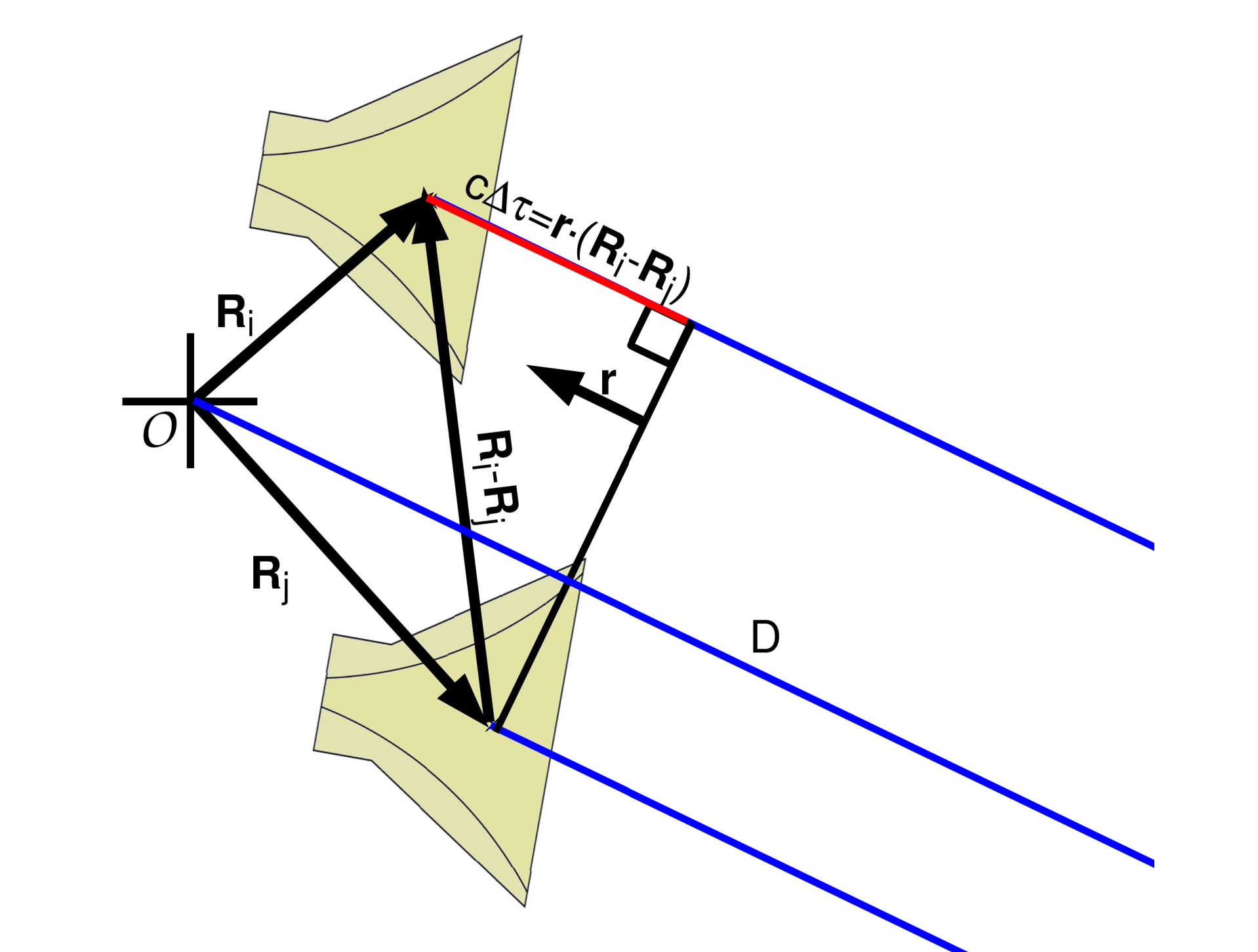
- The time delay between any antenna pair is computed via \( (\bf{X_1} - \bf{X_2}) \cdot \hat{\bf{u}} \) / \(c\)
- \(\bf{X}\) denotes the antenna position,
- \(\hat{\bf{u}}\) is a unit vector that represents the signal direction, and
- \(c\) is the speed of light.
- Each entry in the column time delays [sec] would be a 2D matrix with the same dimensions as the 2D grid generated by _make_grid; let's call them time delay skymaps.
- Each point on a time delay skymap represents the expected time-delay based on where the signal is coming from and where the antennas are on the payload.
- Time delay occurs since the signal has to travel an extra distance to reach the second antenna, after it hits the first antenna:
- As an example, the figure below shows the expected time delays (in seconds) between antenna 203 and 104.
- The time delay between any antenna pair is computed via \( (\bf{X_1} - \bf{X_2}) \cdot \hat{\bf{u}} \) / \(c\)
Time Delays of Signals from Different Directions
Definition at line 89 of file time_delays.py.