Applies SciPy's function minimize() to calibrate antenna phase centers. More...
Functions | |
| pl.DataFrame | generate_antenna_phase_center_pairs_with_placeholders (Path qrh_dot_dat) |
| Creates antenna pairs with placeholder integers as antenna phase centers. | |
| [int] | __get_all_run_numbers (Path pueo_mc_data) |
| A temporary helper function of load_dataset_and_measure_time_delays(). | |
| pl.DataFrame | load_dataset_and_measure_time_delays (ROOT.pueo.Dataset dataset, pl.DataFrame phase_center_pairs) |
| Uses SciPy's correlate() to "measure" the delays of waveforms between antenna pairs. | |
| pl.DataFrame | _scipy_cross_correlate_all_pairs_for_one_event (pl.DataFrame phase_center_pairs, pl.DataFrame waveforms) |
| A helper function of load_dataset_and_measure_time_delays(). | |
| retrieve_relevant_antennas_from_all_pairs (pl.DataFrame phase_center_pairs) | |
| Retrieves the (unique) antennas, given a bunch of antenna pairs. | |
| int | objective_function (pl.Series phase_center_guess, pl.Series phase_center_placeholders, pl.DataFrame pulser_directions_and_measured_time_delays, str axis) |
| Computes the expected time delays and compares them with the measured time delays, designed to be run by SciPy's minimizer. | |
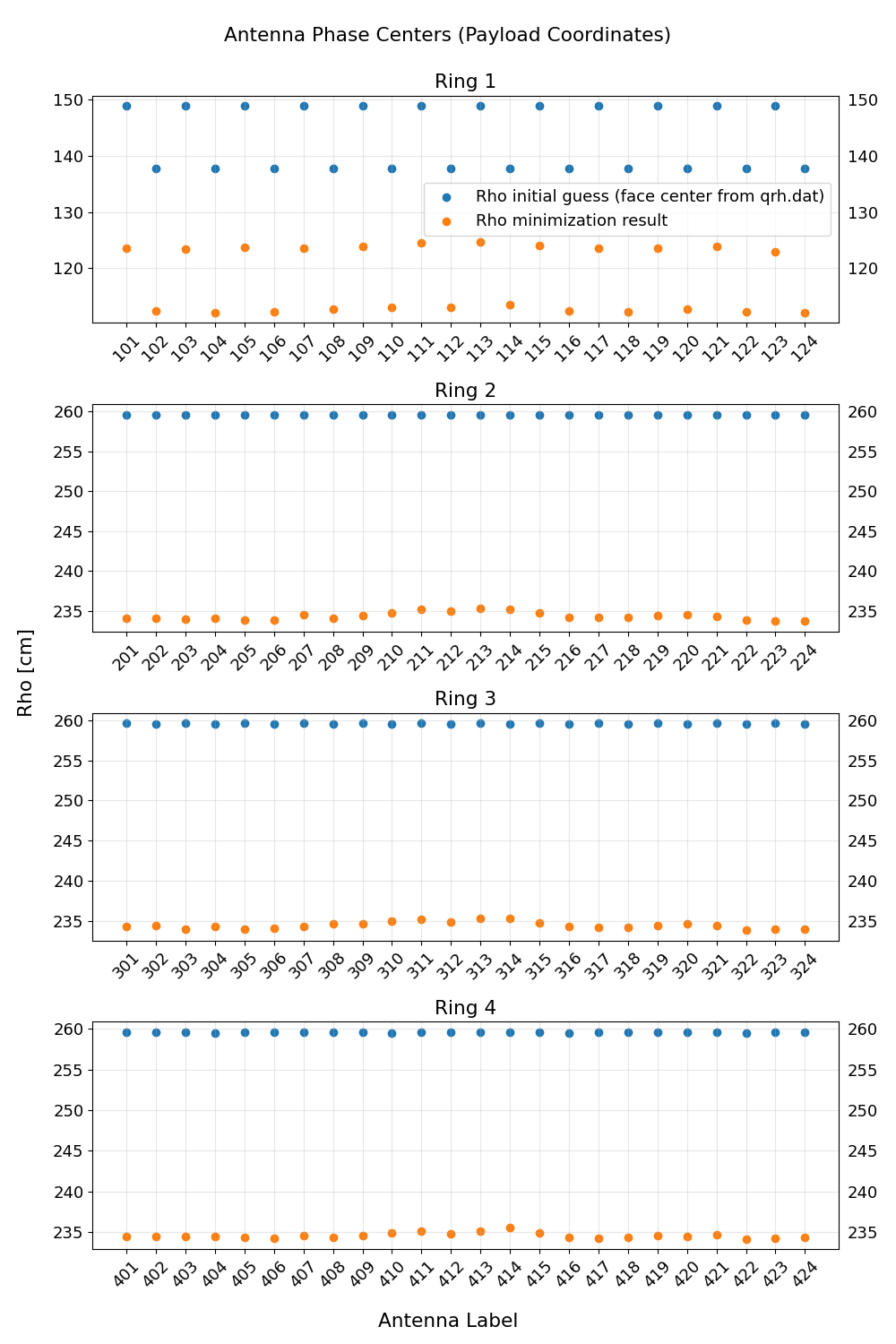
| _plot_calibration_result (str axis, pl.DataFrame before, np.ndarray after) | |
Detailed Description
Applies SciPy's function minimize() to calibrate antenna phase centers.
Function Documentation
◆ generate_antenna_phase_center_pairs_with_placeholders()
| pl.DataFrame generate_antenna_phase_center_pairs_with_placeholders | ( | Path | qrh_dot_dat | ) |
Creates antenna pairs with placeholder integers as antenna phase centers.
- Parameters
-
[in] qrh_dot_dat Path to qrh.dat
- Return values
-
nominal_phase_center_pairs
- Output schema: $ A1_AntNum <enum>$ A1_Ring <u8>$ A1_Rho (placeholder) <u16>$ A1_Phi (placeholder) <u16>$ A1_Z (placeholder) <u16>$ A1_Rho <f64>$ A1_Phi <f64>$ A1_Z <f64>$ A2_AntNum <enum>$ A2_Ring <u8>$ A2_Rho (placeholder) <u16>$ A2_Phi (placeholder) <u16>$ A2_Z (placeholder) <u16>$ A2_Rho <f64>$ A2_Phi <f64>$ A2_Z <f64>
- Details:
- Calls antenna_attributes.read_MI_antenna_geometry() to read qrh.dat to obtain antenna face center positions
- Calls antenna_attributes.get_MI_nominal_phase_center() to convert face centers to nominal phase centers
- Adds three columns to store placeholder values of the phase centers; these integer placeholders serve as dictionary keys. shape: (96, 9)┌────────┬────────┬──────┬────────────────┬────────────────┬───────────────┬──────────┬───────────┬───────┐│ AntNum ┆ AntIdx ┆ Ring ┆ Rho ┆ Phi ┆ Z ┆ Rho ┆ Phi ┆ Z ││ --- ┆ --- ┆ --- ┆ (placeholder) ┆ (placeholder) ┆ (placeholder) ┆ --- ┆ --- ┆ --- ││ enum ┆ u32 ┆ u8 ┆ --- ┆ --- ┆ --- ┆ f64 ┆ f64 ┆ f64 ││ ┆ ┆ ┆ u16 ┆ u16 ┆ u16 ┆ ┆ ┆ │╞════════╪════════╪══════╪════════════════╪════════════════╪═══════════════╪══════════╪═══════════╪═══════╡│ 101 ┆ 0 ┆ 1 ┆ 0 ┆ 96 ┆ 192 ┆ 1.188 ┆ 0.0 ┆ 5.114 ││ 201 ┆ 1 ┆ 2 ┆ 1 ┆ 97 ┆ 193 ┆ 2.296 ┆ 0.0 ┆ 1.457 ││ 301 ┆ 2 ┆ 3 ┆ 2 ┆ 98 ┆ 194 ┆ 2.296 ┆ 0.0 ┆ 0.728 ││ 401 ┆ 3 ┆ 4 ┆ 3 ┆ 99 ┆ 195 ┆ 2.296 ┆ 0.0 ┆ 0.0 ││ 102 ┆ 4 ┆ 1 ┆ 4 ┆ 100 ┆ 196 ┆ 1.076821 ┆ 0.261538 ┆ 4.476 ││ … ┆ … ┆ … ┆ … ┆ … ┆ … ┆ … ┆ … ┆ … ││ 423 ┆ 91 ┆ 4 ┆ 91 ┆ 187 ┆ 283 ┆ 2.295825 ┆ -0.523638 ┆ 0.0 ││ 124 ┆ 92 ┆ 1 ┆ 92 ┆ 188 ┆ 284 ┆ 1.07708 ┆ -0.26224 ┆ 4.476 ││ 224 ┆ 93 ┆ 2 ┆ 93 ┆ 189 ┆ 285 ┆ 2.295502 ┆ -0.261893 ┆ 1.457 ││ 324 ┆ 94 ┆ 3 ┆ 94 ┆ 190 ┆ 286 ┆ 2.295502 ┆ -0.261893 ┆ 0.728 ││ 424 ┆ 95 ┆ 4 ┆ 95 ┆ 191 ┆ 287 ┆ 2.295502 ┆ -0.261893 ┆ 0.0 │└────────┴────────┴──────┴────────────────┴────────────────┴───────────────┴──────────┴───────────┴───────┘
- Calls antenna_pairs.generate_MI_antenna_pairs with the above dataframe as the input.
Definition at line 21 of file calibration.py.
◆ __get_all_run_numbers()
|
private |
A temporary helper function of load_dataset_and_measure_time_delays().
- Parameters
-
[in] pueo_mc_data See the parameter of initialise.load_pueoEvent_Dataset
- This function retrieves the run numbers (negative sign allowed) of the run/ subdirectories in pueo_mc_data
- The runs are returned as a list of integers.
- The function is here only for testing purposes, as it makes little sense to use every single run for antenna calibration.
Definition at line 103 of file calibration.py.
◆ load_dataset_and_measure_time_delays()
| pl.DataFrame load_dataset_and_measure_time_delays | ( | ROOT.pueo.Dataset | dataset, |
| pl.DataFrame | phase_center_pairs ) |
Uses SciPy's correlate() to "measure" the delays of waveforms between antenna pairs.
- Parameters
-
[in] dataset The output of initialise.load_pueoEvent_Dataset [in] phase_center_pairs The output of generate_antenna_phase_center_pairs_with_placeholders
- Return values
-
pulser_directions_and_measured_time_delays
- The input dataset should have been initialized with a (valid) run number, but that is not the only run that gets loaded. For now, all runs are used.
- Output schema: $ measured time delays (ns) <f64>$ max correlation <f64>$ A1_AntNum <enum>$ A1_Ring <u8>$ A1_Rho (placeholder) <u16>$ A1_Phi (placeholder) <u16>$ A1_Z (placeholder) <u16>$ A1_Rho <f64>$ A1_Phi <f64>$ A1_Z <f64>$ A2_AntNum <enum>$ A2_Ring <u8>$ A2_Rho (placeholder) <u16>$ A2_Phi (placeholder) <u16>$ A2_Z (placeholder) <u16>$ A2_Rho <f64>$ A2_Phi <f64>$ A2_Z <f64>$ incoming pulse direction (Phi Theta) <array[f64, 2]>
- The dataset is also used to load the directions of the incoming pulses ( \(^\circ\phi\) and \(^\circ\theta\) in payload coordinates).
- measured time delays (ns) is computed by the helper function _scipy_cross_correlate_all_pairs_for_one_event().
Definition at line 124 of file calibration.py.
◆ _scipy_cross_correlate_all_pairs_for_one_event()
|
protected |
A helper function of load_dataset_and_measure_time_delays().
- Parameters
-
[in] phase_center_pairs The output of generate_antenna_phase_center_pairs_with_placeholders [in] waveforms The output of waveform_plots.load_waveforms
- Return values
-
measured_time_delays
- Output schema: $ measured time delays (ns) <f64>$ max correlation <f64>$ A1_AntNum <enum>$ A1_Ring <u8>$ A1_Rho (placeholder) <u16>$ A1_Phi (placeholder) <u16>$ A1_Z (placeholder) <u16>$ A1_Rho <f64>$ A1_Phi <f64>$ A1_Z <f64>$ A2_AntNum <enum>$ A2_Ring <u8>$ A2_Rho (placeholder) <u16>$ A2_Phi (placeholder) <u16>$ A2_Z (placeholder) <u16>$ A2_Rho <f64>$ A2_Phi <f64>$ A2_Z <f64>
- Details:
- Load the waveforms of both antennas in the antenna pair
- Cross correlate the waveform pair
- Figure out by how much one needs to shift the second waveform against the first in order to achieve the maximum correlation.
- The above is called measured time delays (ns) in the output dataframe.
- For more details, see Explanation.
Definition at line 203 of file calibration.py.
◆ retrieve_relevant_antennas_from_all_pairs()
| retrieve_relevant_antennas_from_all_pairs | ( | pl.DataFrame | phase_center_pairs | ) |
Retrieves the (unique) antennas, given a bunch of antenna pairs.
- Parameters
-
[in] phase_center_pairs The output of load_dataset_and_measure_time_delays
- Return values
-
relevant_antennas
- This step is not trivial, as explained below.
- It is conceivable that not all antennas receive signals clear enough for calibration purposes (resulting in weak correlations).
- As such, the weakly correlated antenna pairs should be filtered out. For example, pulser_directions_and_pairwise_time_delays = (load_dataset_and_measure_time_delays(dataset=ds, phase_center_pairs=nominal_pairs).filter(pl.col("max correlation") > 0.8))
- It is possible that some antennas end up getting filtered out.
- Sample output (note that only 76 out of 96 MI antennas survived the filter in this case): shape: (76, 8)┌────────┬──────┬───────────────────┬───────────────────┬─────────────────┬──────────┬───────────┬───────┐│ AntNum ┆ Ring ┆ Rho (placeholder) ┆ Phi (placeholder) ┆ Z (placeholder) ┆ Rho ┆ Phi ┆ Z ││ --- ┆ --- ┆ --- ┆ --- ┆ --- ┆ --- ┆ --- ┆ --- ││ enum ┆ u8 ┆ u16 ┆ u16 ┆ u16 ┆ f64 ┆ f64 ┆ f64 │╞════════╪══════╪═══════════════════╪═══════════════════╪═════════════════╪══════════╪═══════════╪═══════╡│ 101 ┆ 1 ┆ 0 ┆ 96 ┆ 192 ┆ 1.188 ┆ 0.0 ┆ 5.114 ││ 201 ┆ 2 ┆ 1 ┆ 97 ┆ 193 ┆ 2.296 ┆ 0.0 ┆ 1.457 ││ 301 ┆ 3 ┆ 2 ┆ 98 ┆ 194 ┆ 2.296 ┆ 0.0 ┆ 0.728 ││ 401 ┆ 4 ┆ 3 ┆ 99 ┆ 195 ┆ 2.296 ┆ 0.0 ┆ 0.0 ││ 102 ┆ 1 ┆ 4 ┆ 100 ┆ 196 ┆ 1.076821 ┆ 0.261538 ┆ 4.476 ││ … ┆ … ┆ … ┆ … ┆ … ┆ … ┆ … ┆ … ││ 423 ┆ 4 ┆ 91 ┆ 187 ┆ 283 ┆ 2.295825 ┆ -0.523638 ┆ 0.0 ││ 124 ┆ 1 ┆ 92 ┆ 188 ┆ 284 ┆ 1.07708 ┆ -0.26224 ┆ 4.476 ││ 224 ┆ 2 ┆ 93 ┆ 189 ┆ 285 ┆ 2.295502 ┆ -0.261893 ┆ 1.457 ││ 324 ┆ 3 ┆ 94 ┆ 190 ┆ 286 ┆ 2.295502 ┆ -0.261893 ┆ 0.728 ││ 424 ┆ 4 ┆ 95 ┆ 191 ┆ 287 ┆ 2.295502 ┆ -0.261893 ┆ 0.0 │└────────┴──────┴───────────────────┴───────────────────┴─────────────────┴──────────┴───────────┴───────┘
- If we still pass these filtered antennas to the objective_function, SciPy's minimizer would act as if these antennas are relevant and try to still modify their phase centers during the minization.
Definition at line 285 of file calibration.py.
◆ objective_function()
| int objective_function | ( | pl.Series | phase_center_guess, |
| pl.Series | phase_center_placeholders, | ||
| pl.DataFrame | pulser_directions_and_measured_time_delays, | ||
| str | axis ) |
Computes the expected time delays and compares them with the measured time delays, designed to be run by SciPy's minimizer.
- Parameters
-
[in] phase_center_guess The output of retrieve_relevant_antennas_from_all_pairs [in] phase_center_placeholders The output of retrieve_relevant_antennas_from_all_pairs [in] pulser_directions_and_measured_time_delays The output of load_dataset_and_measure_time_delays [in] axis Axis to fit: \(\rho\), \(\phi\), or \(z\)
- Return values
-
total_difference_bw_expected_time_delay_and_measured_time_delay A scalar
- In load_dataset_and_measure_time_delays(), the measured_time_delay has already been computed.
- The job of this function is to
- Given phase_center_guess, replace the placeholder antenna phase centers in pulser_directions_and_pairwise_time_delays
- Compute the pairwise antenna displacement vectors (call these \(\bf{d}\)), using the updated antenna positions.
- Compute the expected time Signal Delay based on the dot product between \(\bf{d}\) and incoming pulse direction (Phi Theta), see this figure for an illustration. ┌───────────────────────────┬───────────────────────────┐│ measured time delays (ns) ┆ expected time delays (ns) ││ --- ┆ --- ││ f64 ┆ f64 │╞═══════════════════════════╪═══════════════════════════╡│ -0.866667 ┆ -0.853384 ││ -0.866667 ┆ -0.853384 ││ -7.466667 ┆ -7.487111 ││ 0.6 ┆ 0.611216 ││ -9.466667 ┆ -9.48138 ││ … ┆ … ││ 8.333333 ┆ 8.33698 ││ 0.2 ┆ 0.15054 ││ -0.866667 ┆ -0.855732 ││ 0.8 ┆ 0.760589 ││ 1.466667 ┆ 1.463433 │└───────────────────────────┴───────────────────────────┘
- Quantify the difference between the expectation and the measurement; this is done by summing the difference over all rows above.
- SciPy's minimizer tries to minimize the total difference by updating phase_center_guess.
Definition at line 345 of file calibration.py.
◆ _plot_calibration_result()
|
protected |
- Parameters
-
[in] axis Axis to fit: \(\rho\), \(\phi\), or \(z\) [in] before The output of of retrieve_relevant_antennas_from_all_pairs [in] after The restul.x of running scipy.optimize.minimize on objective_function
Nothing crazy here!
Definition at line 427 of file calibration.py.